

How I Build Scalable Django Applications
A practical guide to how I design and build scalable Django applications using clean architecture, PostgreSQL, Redis, Celery, Docker, and modern software engineering practices."
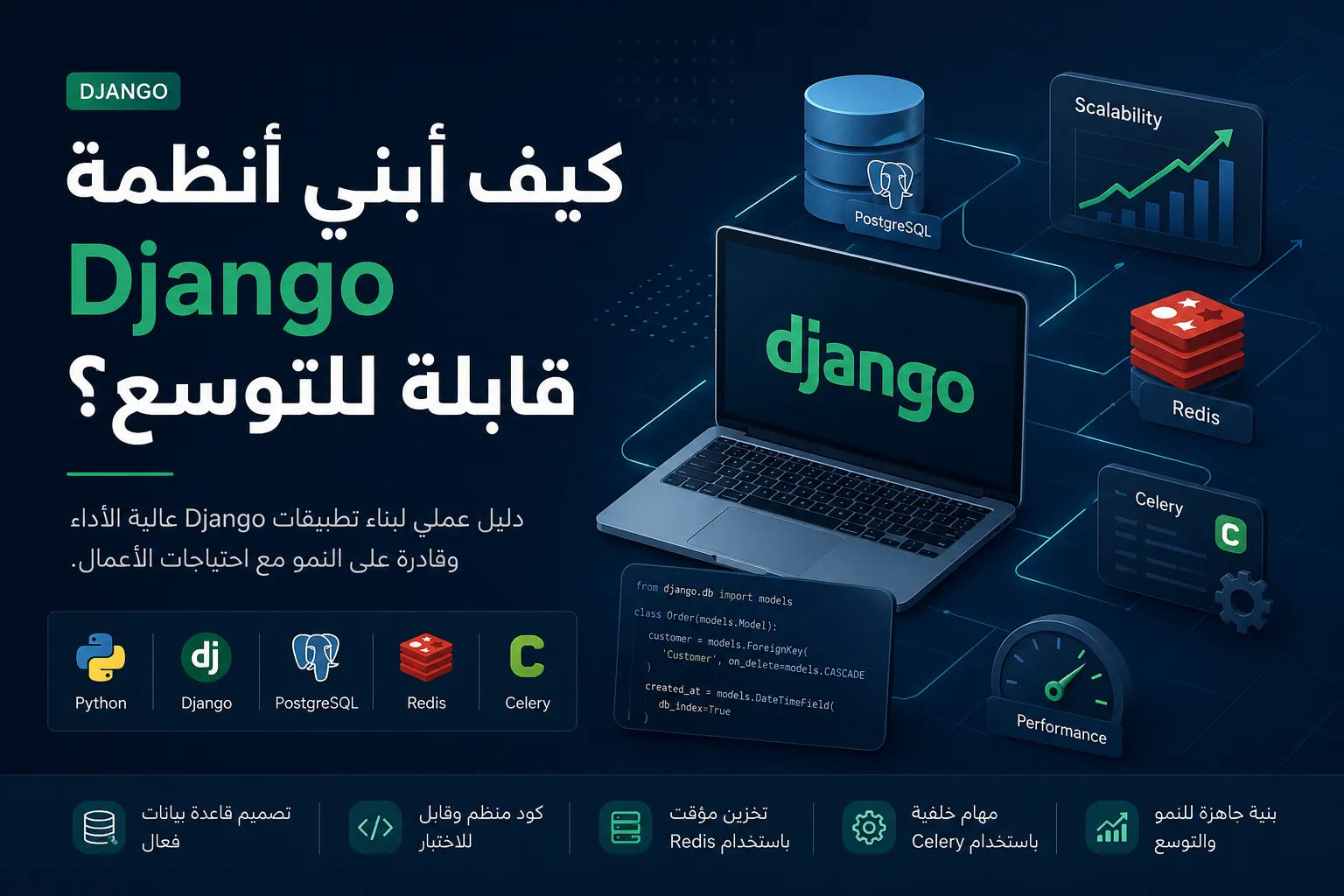
How I Build Scalable Django Applications
When I start a new Django project, I don't just think about making it work today. I think about how it will perform a year from now when the number of users, transactions, and business requirements has grown significantly.
One of the most common mistakes in software development is building applications solely for current needs. As the project grows, technical debt accumulates, performance declines, and adding new features becomes increasingly difficult.
Over the years, I've developed a set of principles and practices that help me build Django applications that are scalable, maintainable, and ready for long-term growth.
In this article, I'll share the approach I use when designing and developing scalable Django systems.
What Does Scalability Mean?
Scalability is the ability of a system to handle growth without sacrificing performance, reliability, or maintainability.
Growth can come in many forms:
- More users
- More data
- More API requests
- More business processes
- More integrations
The goal isn't to over-engineer from day one. The goal is to create a solid foundation that allows the application to grow naturally over time.
1. Start with a Well-Designed Database
Most performance issues in large applications begin at the database level.
That's why I spend significant time designing:
- Relationships
- Constraints
- Indexes
- Query patterns
before writing large amounts of application logic.
Use Proper Relationships
Django's ORM makes it easy to define relationships, but thoughtful design is critical.
I rely on:
- Foreign Keys
- Many-to-Many Relationships
- Unique Constraints
- Database-level validation
to maintain data integrity and improve performance.
Add Indexes Where They Matter
Fields frequently used in:
- Search
- Filtering
- Sorting
- Lookups
should usually be indexed.
Example:
class Customer(models.Model):
    name = models.CharField(max_length=255)
    email = models.EmailField(db_index=True)
Small indexing decisions can dramatically improve query performance as data grows.
2. Organize Projects into Domain-Based Apps
One of the mistakes I often see is placing everything inside a single Django app.
Instead, I organize projects around business domains.
For example:
customers/
sales/
inventory/
orders/
payments/
notifications/
This approach provides:
- Better maintainability
- Clear separation of concerns
- Easier testing
- Faster onboarding for new developers
As the project grows, a modular structure becomes increasingly valuable.
3. Keep Business Logic Out of Views
Views should remain lightweight.
Instead of placing large amounts of business logic inside a view:
def create_order(request):
    # hundreds of lines of logic
I prefer moving business rules into dedicated services:
def create_order(request):
    OrderService.create(...)
Example:
class OrderService:
    @staticmethod
    def create(data):
        ...
Benefits include:
- Easier testing
- Better reusability
- Cleaner code organization
- Reduced coupling
4. Optimize Database Queries Early
One of the most common performance issues in Django applications is the N+1 Query problem.
Instead of:
orders = Order.objects.all()
I often use:
orders = (
    Order.objects
    .select_related("customer")
    .prefetch_related("items")
)
This dramatically reduces database queries and improves response times.
Performance optimization becomes much easier when it's considered early rather than after problems appear.
5. Use Caching Strategically
Not every request should trigger expensive database operations.
That's where Redis becomes essential.
I commonly cache:
- Dashboard statistics
- Reports
- Configuration data
- Frequently accessed records
- Search results
Example:
from django.core.cache import cache

data = cache.get("dashboard_stats")

if not data:
    data = calculate_stats()
    cache.set("dashboard_stats", data, 300)
Caching can significantly reduce database load and improve user experience.
6. Move Heavy Tasks to Background Workers
Long-running operations should not block user requests.
Examples include:
- Sending emails
- Processing files
- Generating reports
- External API integrations
- AI processing
For these scenarios, I use Celery with Redis.
Instead of:
generate_report()
I use:
generate_report.delay()
This allows users to continue working while tasks execute in the background.
7. Design APIs for Growth
When building APIs with Django REST Framework, I focus on efficiency from the beginning.
Essential features include:
- Pagination
- Filtering
- Search
- Ordering
Instead of returning thousands of records at once, APIs should provide manageable responses.
Example:
?page=1&page_size=20
This improves both performance and user experience.
8. Build Flexible Authorization Systems
Business applications rarely have a single user type.
That's why I prefer Role-Based Access Control (RBAC).
Rather than:
if user.is_admin:
I design systems around:
- Roles
- Permissions
- Groups
- Access policies
This makes applications more flexible and easier to evolve as business requirements change.
9. Support Multi-Tenant Architectures When Needed
Many SaaS platforms require data isolation between organizations.
For these situations, I often implement Multi-Tenant Architecture.
Benefits include:
- Shared infrastructure
- Tenant isolation
- Easier maintenance
- Lower operational costs
This approach is particularly useful for business management platforms and enterprise software.
10. Monitor Performance from Day One
Performance should never be an afterthought.
I regularly use tools such as:
- Django Debug Toolbar
- Structured Logging
- Sentry
- PostgreSQL Query Analysis
Monitoring helps identify bottlenecks before they become production issues.
11. Use Docker Everywhere
One of the most common sources of deployment issues is environmental inconsistency.
Docker helps solve this problem by ensuring that applications run the same way across:
- Development
- Testing
- Staging
- Production
This consistency reduces deployment risks and improves team productivity.
12. Introduce Microservices Only When Necessary
I don't start projects with a microservices architecture.
In most cases, I begin with a modular monolith.
As the application grows, specific components can be extracted into independent services, such as:
- Notification services
- Search services
- Reporting services
- AI services
This approach avoids unnecessary complexity while preserving future flexibility.
The Most Important Lesson I've Learned
Scalability is not about building the most complex architecture possible.
It's about making smart engineering decisions consistently.
A scalable Django application is usually the result of:
- Good database design
- Clean architecture
- Clear separation of concerns
- Efficient queries
- Background processing
- Performance monitoring
The earlier these principles are adopted, the easier growth becomes.
Final Thoughts
Building scalable Django applications isn't about a specific package, framework, or architectural trend. It's about creating a strong foundation that can support future growth without becoming difficult to maintain.
By focusing on database design, modular architecture, efficient queries, caching, background processing, Docker, and sound engineering practices, I've been able to build business systems, SaaS platforms, and enterprise applications that continue to perform as requirements evolve.
Scalability is not a feature you add later. It's a mindset that influences every technical decision from the very beginning.
About the Author
Taher Ali Mahram is a Software Engineer specializing in Backend Development, Django, FastAPI, AI Systems, and scalable business applications. He focuses on designing software architectures that balance performance, maintainability, and long-term growth.