

The Technologies I Use Every Day as a Backend Developer
A look at the technologies and tools I use daily as a Backend Developer, including Python, Django, FastAPI, PostgreSQL, Docker, Linux, and modern AI technologies.
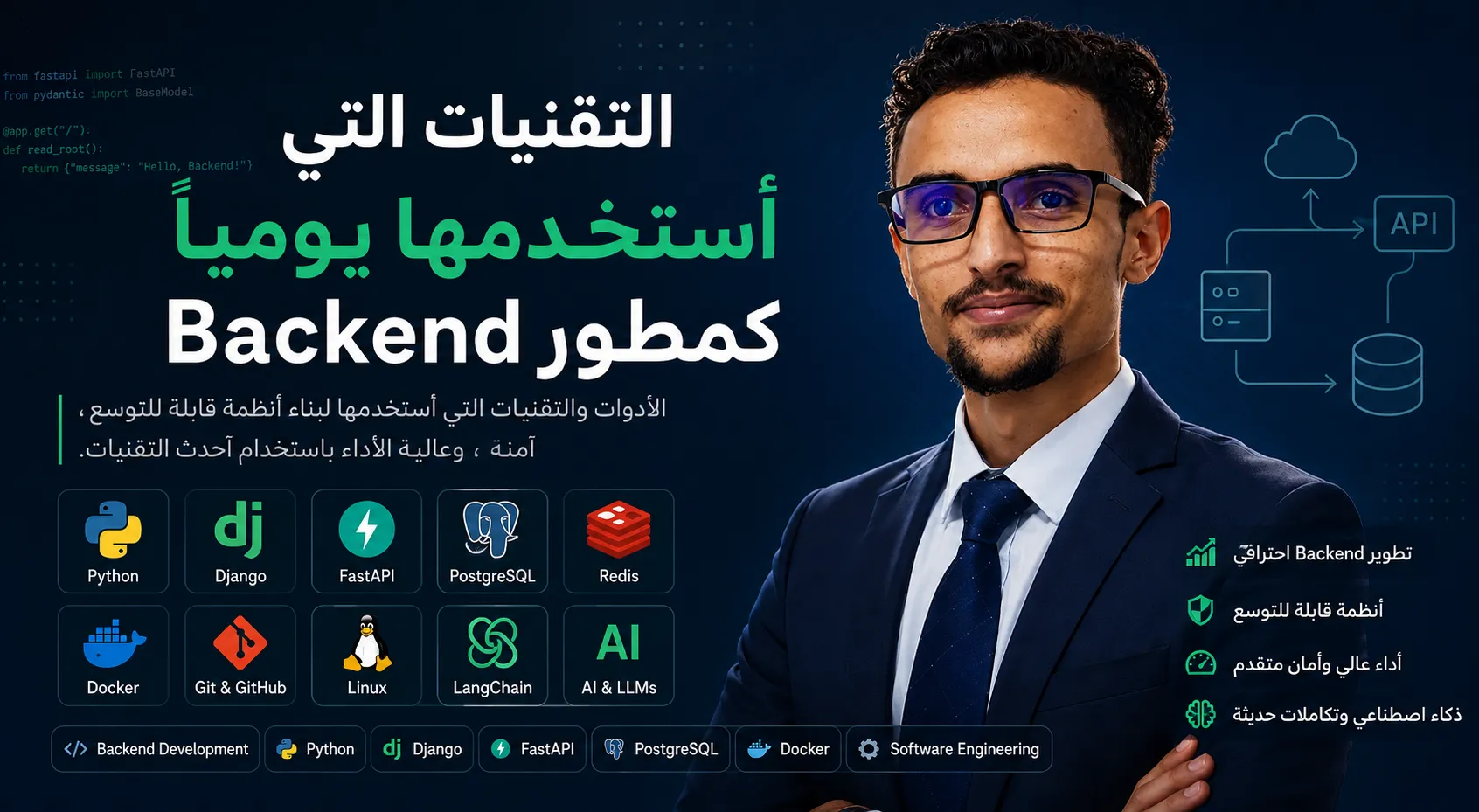
The Technologies I Use Every Day as a Backend Developer
As a Backend Developer, my primary focus is building scalable, reliable, and maintainable systems that solve real business problems. Over the years, I have worked with various technologies, but a core set of tools has become part of my daily workflow.
These technologies help me design robust architectures, build high-performance APIs, automate business processes, and integrate modern AI capabilities into software products.
In this article, I'll share the technologies I use every day and explain why they are an essential part of my development stack.
Python: My Primary Programming Language
Python is the foundation of most projects I build.
I choose Python because it offers:
- Clean and readable syntax
- Rapid development capabilities
- A massive ecosystem of libraries
- Excellent support for web development and AI
- Strong community support
Whether I'm building a business management platform, an API service, or an AI-powered application, Python is usually where I start.
Django: The Backbone of Business Applications
For complex business systems, Django remains my preferred web framework.
What makes Django powerful is its ability to provide everything needed to build production-ready applications:
- Robust ORM
- Authentication and authorization systems
- Admin panel
- Security best practices
- Scalability and maintainability
I have used Django to develop CRM systems, sales management platforms, multi-tenant applications, workflow automation systems, and enterprise-grade business solutions.
Its mature ecosystem allows me to focus on solving business problems rather than reinventing common functionality.
FastAPI: High-Performance APIs and Microservices
While Django is my primary framework, FastAPI has become an important part of my toolkit.
I typically use FastAPI when building:
- High-performance APIs
- Microservices
- AI services
- Real-time integrations
- Data processing endpoints
The benefits include:
- Exceptional performance
- Native asynchronous support
- Automatic API documentation
- Type safety
- Developer-friendly experience
FastAPI is an excellent choice when speed and efficiency are critical.
PostgreSQL: My Database of Choice
When it comes to relational databases, PostgreSQL is my default choice.
Why PostgreSQL?
- Reliability
- Advanced querying capabilities
- Strong performance
- Excellent indexing features
- Scalability
Most of the systems I develop rely on PostgreSQL because it provides the flexibility and stability required for long-term growth.
Redis: Improving Performance and Scalability
Not every request should hit the database.
Redis helps improve application performance through:
- Caching
- Session management
- Task queues
- Rate limiting
- Temporary data storage
In large-scale applications, Redis often plays a critical role in reducing response times and improving user experience.
Docker: Consistent Development and Deployment
One of the biggest challenges in software development is ensuring consistency between development and production environments.
Docker solves this problem by allowing applications to run inside containers.
I use Docker to:
- Standardize environments
- Simplify deployments
- Improve team collaboration
- Reduce infrastructure issues
- Support scalable deployments
Today, Docker is a standard component of nearly every project I work on.
Git and GitHub
Version control is essential for professional software development.
I use Git every day for:
- Source code management
- Feature branching
- Code reviews
- Collaboration
- Release management
GitHub serves as the central hub for repositories, issue tracking, project management, and continuous integration workflows.
Linux: My Preferred Development Environment
Most production servers run on Linux, making it an important part of my daily workflow.
Linux allows me to:
- Manage servers efficiently
- Monitor system performance
- Automate operational tasks
- Configure production environments
- Troubleshoot infrastructure issues
For Backend Developers, Linux knowledge is a valuable skill that directly impacts productivity and system reliability.
AI Development with LangChain and LLMs
Artificial Intelligence is becoming increasingly important in modern software products.
I actively work with:
- OpenAI APIs
- LangChain
- Retrieval-Augmented Generation (RAG)
- Vector Databases
- AI Agents
- Semantic Search Systems
These technologies enable businesses to build intelligent assistants, automate knowledge retrieval, and create AI-powered user experiences.
As AI continues to evolve, integrating these capabilities into backend systems has become one of the most exciting areas of software engineering.
React and Next.js When Full-Stack Development Is Needed
Although backend development is my primary specialization, I also work with React and Next.js when projects require modern frontend experiences.
This allows me to:
- Deliver complete solutions
- Understand frontend requirements
- Collaborate effectively with frontend teams
- Build full-stack applications when necessary
Having frontend knowledge helps me design better APIs and improve the overall developer experience.
How I Choose the Right Technology
I don't believe in using the same technology for every project.
Instead, I evaluate factors such as:
- Project complexity
- Expected scale
- Performance requirements
- Team expertise
- Long-term maintenance needs
- AI integration requirements
The best technology stack is the one that solves the problem efficiently while remaining maintainable in the future.
Final Thoughts
Technology is constantly evolving, but the goal remains the same: building software that delivers value.
My daily toolkit includes Python, Django, FastAPI, PostgreSQL, Redis, Docker, Linux, and modern AI technologies such as LangChain and RAG systems. Together, these tools allow me to create scalable backend architectures, intelligent applications, and reliable business solutions.
While tools are important, successful software development ultimately comes down to understanding problems, designing effective solutions, and building systems that stand the test of time.
About the Author
Taher Ali Mahram is a Software Engineer specializing in Backend Development, AI Systems, Django, FastAPI, PostgreSQL, cloud infrastructure, and scalable business applications. He focuses on building reliable software solutions that combine strong engineering principles with modern AI capabilities.